Apply Discount Code
Bachmann
35-626SF
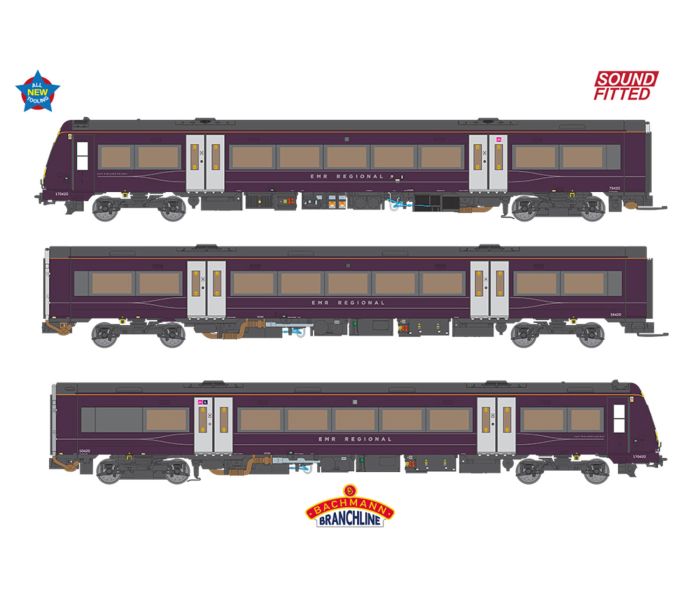
Class 170 420 EMR Regional 3 Car DMU (DCC-Sound)

Pre-order item - not yet released
SKU
B35-626SF
Scale
1:76 Scale, OO Scale
Part Number
35-626SF
Expected:
Q1/2027
RRP
RRP
£569.95
£484.50
SAVING YOU £85.45 (15%) OFF RRP
Description
Class 170 420 EMR Regional 3 Car DMU (DCC-Sound)
1:76 scale model produced by Bachmann. This model is ready-to-run straight out of the box and would make a excellent addition to any model railway collection.
Features:
- DCC Sound Model
- This model mainly operates in Britain
- Decorated in East Midlands Railway company markings
- Best suited to 438mm radius curves
- Bachmann Branchline OO Scale
- Era 9
- Pristine East Midlands Railway (EMR Regional) livery
- Running No. 170420
- Three-Car Unit comprising car Nos. 50420, 56420 & 79420
- Destination blinds for Nottingham
- Length 922mm
Details
Each three-car unit in the British Rail Class 170 / British Rail Class 171 range is formed of two powered driving vehicles, delivering smooth and reliable performance. The advanced low-level drive train ensures an almost invisible mechanism, preserving the realism of the model while maintaining excellent running characteristics. A three-pole motor with a flywheel drives the inner bogie, supported by twin axle drive and separate metal bearings on each driven axle for consistent power delivery. Trailing axles run in metal pinpoint bearings, while electrical pickup is collected from all wheels to maximise reliability. A diecast metal, multi-stage gearbox is engineered for prototypical speeds and strong haulage capabilities. The models are fitted with 16.5mm (OO gauge) wheels manufactured to NEM310 and NEM311 standards, complete with authentic profiles. At the cab ends, working miniature BSI or Dellner couplings (depending on the variant) are fitted, while conductive close couplings with integrated mechanisms are installed at the gangway ends. The unit is designed to operate comfortably on curves of second radius (438mm) or greater.
Attention to detail is a defining feature of these models. Precision-moulded bodyshells feature finely engraved panel lines, doors, and vents, complemented by prototypical ribbon glazing along the bodysides and flush glazing for doors and windscreens. Separately applied etched metal roof grilles and windscreen wipers further enhance realism, while authentic bogie mouldings include brake and suspension detail. The underframe is fully realised with numerous separately fitted, high-fidelity components. Inside, the passenger saloon is fully detailed with tables, seating, and partition walls, and the driver’s cab includes a detailed control desk, seating, and rear bulkhead. Each model is supplied with an accessory pack and a coupling tool to assist with handling and configuration.
Lighting functions are comprehensive and highly configurable. Directional lighting includes a selectable Day/Night mode, operable via chassis-mounted switches or dedicated DCC functions. Lights at each end can be controlled independently, and illuminated destination panels are provided, including central bodyside displays where appropriate. Passenger saloon lighting can be switched on or off, and additional features such as cab lighting at the trailing end and door interlock lights are available when operating on DCC. All lighting uses carefully selected colours and temperatures to reflect real-world operation.
For digital users, the model includes a Plux22 DCC decoder interface, requiring only one decoder per unit. The socket is easily accessible behind a removable panel on the underside of the master driving car. When used on DCC, the integrated Bach-Up Stay Alive system ensures uninterrupted power, helping to eliminate stalling, flickering lights, and sound interruptions.
Sound capability is a standout feature, with two speakers fitted—one in each driving vehicle—to provide balanced and immersive audio. SOUND FITTED versions come equipped with an ESU LokSound V5 DCC Sound Decoder, pre-loaded with sound files specifically developed for the Bachmann Branchline Class 170/171 DMU using recordings from real units. These versions are designed to operate on both DCC and analogue control straight from the box.
Finally, the livery application reflects a high level of authenticity. Each vehicle is finished in accurate, prototypical liveries, including interior decoration. Multiple paint applications are used, employing corporate specification colours, while logos, numbering, and text are applied through a multi-stage tampo printing process using correct typefaces and branding.
Historical Background
Production of the first Turbostars began in 1997, shortly after the Privatisation of British Rail, when Chiltern Railways placed an order for what became the British Rail Class 168. Early examples, classified as 168/0, featured interim Networker-style cabs while the now familiar Turbostar front end was finalised. Later batches, 168/1 and 168/2, introduced the definitive cab design recognised by enthusiasts today. These units were equipped with BSI couplings and compatible electrical systems, allowing seamless operation with inherited Network SouthEast stock. This operational flexibility is often reflected in realistic model railway formations.
The highly successful British Rail Class 170 soon followed, with the first order placed by Midland Mainline. Deliveries began in November 1998, with passenger service commencing in May 1999. Built over a seven year period, more than 120 units were produced in both 2 car and 3 car formations for operators across the UK. Unlike the Class 168, the Class 170 featured standard electrical connections alongside BSI couplings, enabling multiple working with the widely used Class 15x Sprinter fleet. For modellers, the variety of subclasses, often determined by operator, formation, and interior specification, provides a rich source of prototypical variation in liveries and train consists.
A further development came with the British Rail Class 171, ordered by Southern Railway (UK). Delivered from 2003 to 2004, these units introduced Dellner couplings in place of the BSI type and featured electronic destination displays on the bodysides. Southern’s earlier 2 car Class 170 units were subsequently modified with Dellner couplings and reclassified as 171/7, while new build units formed the 171/8 subclass. These technical distinctions are particularly relevant for accurate model representation, especially when modelling multiple working or specific regional operations.
Today, the Turbostar family remains a mainstay of the UK rail network, a longevity that enhances their appeal for contemporary model railway layouts. With a top speed of 100mph and a reputation for versatility, they continue to operate on both regional and longer distance services. The Class 168 and 171 fleets remain with Chiltern Railways and Southern respectively, while Class 170 units are currently in service with operators including CrossCountry, East Midlands Railway, Northern Trains, and ScotRail. For enthusiasts and modellers alike, the Turbostar story offers a compelling blend of technical evolution, operational diversity, and enduring relevance on today’s railway.
More Information
| SKU | B35-626SF |
|---|---|
| Manufacturer | Bachmann |
| Barcode | 803393079192 |
| Manufacturer Code | 35-626SF |
| Scale/Gauge | 1:76 Scale, OO Scale |
| Product Type | Locomotive |
| Locomotive Control Setup | DCC Sound |
| Locomotive Power Type | Diesel |
| Continent/Region | UK |
| Country | British |
| Operator | East Midlands Railway |
| Locomotive Class | Class 170 |
Select Your Free Gift
- Price:
- Actual Price: