Bachmann New Items Announced
The Bachmann Autumn 2025 British Railway Announcements are here, bringing with it an exciting line-up of new releases.
Steam Locomotives
J71 Locomotives
The LNER Class J71, originally the North Eastern Railway Class E, was a compact 0-6-0T steam locomotive designed by T.W. Worsdell and built between 1886 and 1895, with a total of 120 produced. These inside-cylinder engines featured Stephenson valve gear and slide valves, initially lacking Joy valve motion and compound expansion, rendering them a side-tank development of the earlier '44' class.
Their 140 psi boiler, 11.3 ft² fire-grate, and tractive effort of about 12,130 lbf made them adept shunters in yards and docks. Seventy-eight entered British Railways, ending service in the early 1960s—none survive today.
E4 Locomotives
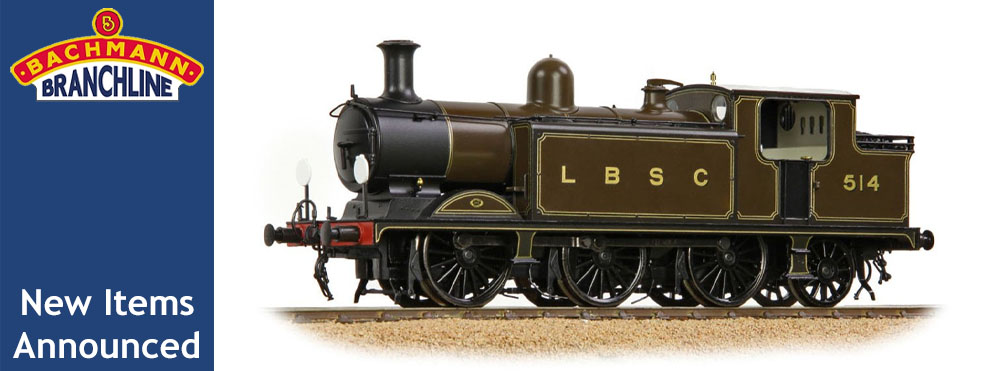
The London, Brighton & South Coast Railway (LB&SCR) Class E4 0-6-2T “Radial Tank” was a highly versatile steam locomotive designed by Robert Billinton and first introduced in 1897. A development of William Stroudley’s earlier designs, the E4 became the most numerous member of the Radial Tank family, with 75 locomotives built at Brighton Works over a six-year period.
Designed for mixed-traffic duties, the E4 handled everything from suburban passenger trains to light freight services, and many later served as station pilots at London Waterloo.
8F Locomotives
The LMS Stanier Class 8F 2-8-0 was one of the most important heavy freight locomotives in British railway history. First introduced in 1935, the class became the standard freight engine of the London, Midland & Scottish Railway (LMS), with production expanding dramatically during the Second World War.
By 1945, a total of 852 locomotives had been built, many under the direction of Robert Riddles, who ensured the 8F became the War Department’s standard locomotive for overseas service.
Diesel Locomotives
Wickham Trolley Cars
Class 30 Locomotives
The BR Class 30 and Class 31 diesel locomotives, originally known as the Brush Type 2s, were built by Brush Traction between 1957 and 1962, with 263 constructed. Introduced as part of the British Railways Pilot Scheme to replace steam, the first entered service in November 1957. Initially allocated to the Eastern Region, they soon spread to the Western and London Midland Regions.
Early Class 30s used unreliable Mirrlees engines, but between 1965 and 1969 the entire fleet was re-engined with English Electric 12SVT engines, becoming Class 31s. The standard 31/1s featured Blue Star multiple-working equipment and steam heating, working on passenger, parcels, and freight services across the network. Later sub-classes included 31/4s fitted with Electric Train Heating, while refurbishment in the 1980s modernised their appearance.
Withdrawals began in 1975, yet many survived into the 1990s under EWS and other operators. Today, more than 25 locomotives are preserved.
Class 31 Locomotives
The BR Class 31 diesel locomotives, originally Brush Type 2s, became a familiar sight across Britain from the late 1950s. The standard Class 31/1s were fitted with Blue Star multiple-working equipment and steam heating, making them versatile for passenger, parcels, and freight duties. They worked widely across the Eastern Region, particularly from Stratford, March, Finsbury Park, Tinsley, Immingham, and Thornaby, with allocations also at Bristol Bath Road, Old Oak Common, Healey Mills, and Bescot.
From the 1970s, some locomotives were upgraded with Electric Train Heating (ETH) and reclassified as Class 31/4s. A major 1980s refurbishment modernised their appearance with plated headcodes, twin marker lights, and the removal of boilers. Departmental sub-classes included 31/5s, with ETH isolated, and 31/6s, wired for double-heading with ETH-fitted locomotives.
Withdrawals began in 1975, but the Class remained in service into the 1990s under EWS and other operators. Today, over 25 locomotives are preserved, securing the Class 31’s place in railway history.
Class 69 Locomotives
The Class 69 diesel locomotive was introduced by GB Railfreight (GBRf) to meet demand for modern, high-performance freight traction. With new Class 66s no longer available, GBRf opted to rebuild redundant Class 56 locomotives, converting them with new systems and EMD 710 engines—the same as those powering the Class 66. Conversion work was undertaken by Progress Rail in Stoke-on-Trent, using donor locomotives built at BREL Crewe, BREL Doncaster, and Electroputere Romania.
Announced in 2019, the first rebuilt locomotive, No. 69001 “Mayflower”, ran trials on the Severn Valley Railway in early 2021 and entered service later that year following approval by the Office of Rail and Road. The initial order was for ten locomotives (69001–69010), with an option for six more.
Electric Multiple Units
The British Rail Class 414 (2-HAP) was a standard 2-car 90 mph Electric Multiple Unit (EMU) introduced on the Southern Region between 1957 and 1963. Designed for express passenger services, the 2-HAPs were compatible with other EMUs, including the Class 411 4-CEP. The name “2-HAP” evolved from the earlier 2-HAL units—2-car sets with Half-A-Lavatory—but the addition of electro-pneumatic brakes led to the final “P” in the designation.
Built across four batches, the units featured variations in motor bogies, control equipment, and cab-end arrangements. Early Phase 1 units (1951- and 1957-type) had roof-mounted lighting conduits, while later Phase 2 units introduced Mk3B and Mk4 motor bogies and modified cab ends.
Originally numbered 6001–6173, the fleet was later TOPS-classified as 414/2 and 414/3. Withdrawals began in 1982 due to asbestos concerns, with the final units retired in 1995, marking the end of the 2-HAPs’ Southern Region service.
Wagons and Wagon Packs
Scenecraft Buildings and Accessories
You can view the full Bachmann range on our website through the button below.